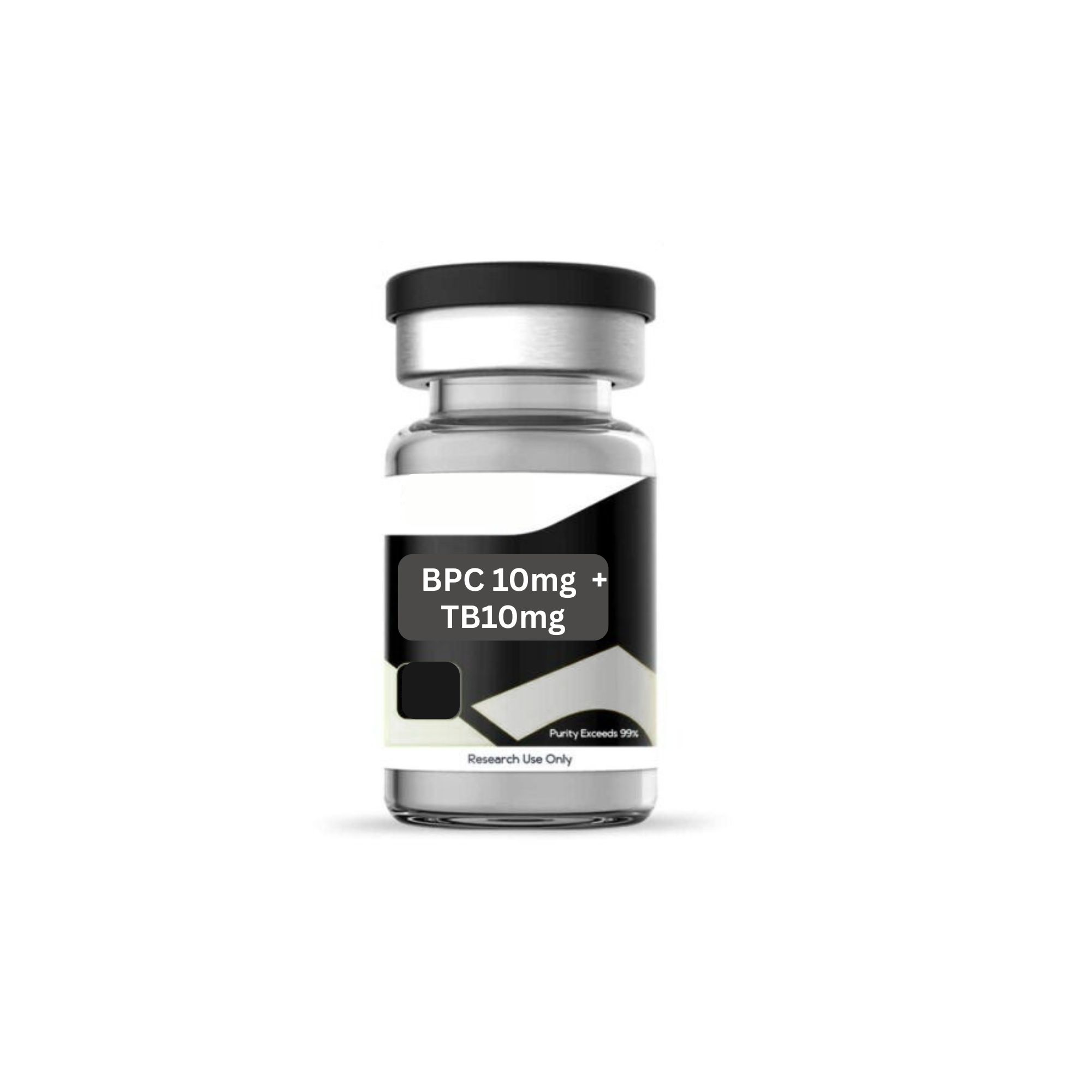
BPC 10MG + TB10MG (Body Protection Compound 157) is a stable gastric pentadecapeptide recognized for its significant healing properties across various tissues and conditions. It has been studied for its potential in wound healing, musculoskeletal injuries, cytoprotection, and angiogenesis.
BPC-157 Description BPC 10MG + TB10mg
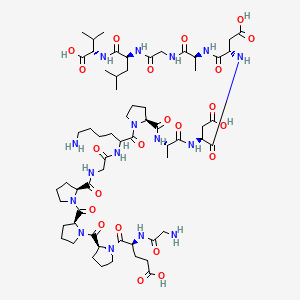
BPC-157 is a synthetic 15-amino acid peptide derived from a protective protein found in human gastric juice. With the sequence Gly-Glu-Pro-Pro-Pro-Gly-Lys-Pro-Ala-Asp-Asp-Ala-Gly-Leu-Val, it exhibits stability against enzymatic degradation and gastric acidity. While not naturally occurring as an isolated fragment, its parent protein contributes to gastrointestinal protection and repair. The peptide exhibits multifaceted mechanisms, including tissue repair promotion via activation of growth hormone receptors and pathways like JAK2, which enhance collagen synthesis and fibroblast activity.
Peptide Information
| Property | Value |
|---|---|
| Peptide Sequence | Gly-Glu-Pro-Pro-Pro-Gly-Lys-Pro-Ala-Asp-Asp-Ala-Gly-Leu-Val |
| Molecular Formula | C62H98N16O22 |
| Molecular Weight | 1419.5 g/mol |
| CAS Number | 137525-51-0 |
| PubChem CID | 108101 |
| Synonyms | A886440, L-Valine, glycyl-L-a-glutamyl-L-prolyl-L-prolyl-L-prolylglycyl-L-lysyl-L-prolyl-L-alanyl-L-a-aspartyl-L-a-aspartyl-L-alanylglycyl-L-leucyl- Acetate |
BPC-157 Peptide Structure
Lyophilized Peptides
These peptides are freeze-dried, a process that not only extends shelf life but also preserves the purity and integrity of the peptides during storage. We do not use any fillers in this process.
BPC-157 Research
BPC-157 is a promising peptide with diverse research applications in wound healing, musculoskeletal injuries, and cytoprotection. Its ability to promote angiogenesis and protect against vascular and epithelial damage highlights its potential for broader clinical research.
Wound Healing
BPC-157 promotes the formation of granulation tissue, angiogenesis, and collagen production, which are critical for wound healing. It has been shown to enhance vascular endothelial growth factor (VEGF) expression, which is crucial for new blood vessel formation.1
The peptide enhances the proliferation and migration of endothelial cells and fibroblasts, which are essential for tissue repair. It activates pathways such as ERK1/2 and FAK-paxillin, which are involved in cell growth and migration.2
BPC-157 exhibits significant anti-inflammatory properties, which may contribute to its effectiveness in healing inflammatory skin lesions and other tissue injuries.3
BPC-157 has been effective in treating various skin injuries, including incisional/excisional wounds, deep burns, and diabetic ulcers. It accelerates wound closure and improves tissue remodeling and collagen deposition.4
Although the peptide’s healing mechanisms are partially understood, more research is needed to fully elucidate its pathways and interactions, particularly in complex wound healing scenarios.
Musculoskeletal Healing
BPC-157 has shown significant promise in enhancing tendon and ligament healing. It accelerates tendon fibroblast outgrowth, increases cell survival under stress, and promotes cell migration, likely through the activation of the FAK-paxillin pathway.5
BPC-157 enhances growth hormone receptor expression in tendon fibroblasts, which may potentiate the proliferation-promoting effects of growth hormone, contributing to tendon healing.6
The peptide has demonstrated efficacy in healing transected muscles and restoring myotendinous junctions in animal models. It counteracts muscle atrophy and promotes full functional recovery, as evidenced by improved biomechanical and functional assessments in treated rats.7
BPC-157 has also been shown to improve the healing of segmental bone defects in rabbits, comparable to traditional treatments like bone marrow or autologous cortical grafts.8
Angiogenesis
BPC-157 has been shown to promote angiogenesis through several mechanisms. It increases the expression and internalization of vascular endothelial growth factor receptor 2 (VEGFR2), which is crucial for angiogenic signaling. This activation leads to the stimulation of the VEGFR2-Akt-eNOS signaling pathway, enhancing endothelial tube formation and blood flow recovery in ischemic tissues.9
BPC-157 modulates the Src-Caveolin-1-eNOS pathway, promoting nitric oxide production and vasodilation, which are essential for vascular health and angiogenesis.10
BPC-157 has demonstrated significant angiogenic effects in various healing models. It enhances the healing of muscle and tendon injuries by up-regulating VEGF expression, which is vital for angiogenesis and tissue repair. 11
Gastrointestinal Conditions
BPC-157 is known for its strong endothelial protection, which plays a crucial role in its ability to heal gastric and duodenal lesions. It effectively counteracts the damage induced by stress, cysteamine, and ethanol in experimental models, outperforming several standard treatments.12
BPC-157 has demonstrated significant protective effects against various GI injuries, including those caused by NSAIDs, alcohol, and stress. It stabilizes intestinal permeability and enhances cytoprotection, making it a promising candidate for mitigating NSAID-induced gastroenteropathy and leaky gut syndrome.13
The peptide has also shown efficacy in healing fistulas14 and promoting recovery in conditions like ulcerative colitis and multiple sclerosis.15
Ocular Health
BPC-157 has shown significant promise in treating glaucoma, particularly in models where episcleral veins are cauterized, leading to increased intraocular pressure. The peptide rapidly normalizes intraocular pressure and preserves the integrity of retinal ganglion cells and optic nerves. It achieves this by enhancing collateral pathways, which compensates for the occlusion of major vessels, thereby preventing glaucomatous damage.16
In cases of retinal ischemia induced by retrobulbar application of L-NAME, BPC-157 has been effective in counteracting the adverse effects. It restores normal blood vessel diameter and optic disc appearance, and maintains retinal thickness, thus preventing further ischemic damage. This effect is attributed to BPC-157’s interaction with the NO-system, which plays a crucial role in vascular health.17
BPC-157 has demonstrated efficacy in promoting corneal healing and maintaining transparency. It accelerates the healing of corneal epithelial defects and prevents neovascularization, which is crucial for preserving corneal clarity. This healing effect is observed in various models of corneal injury, including perforating corneal incisions.18
The peptide also shows potential in treating dry eye syndrome by counteracting the effects of lacrimal gland removal. BPC-157’s ability to heal ocular tissues and its established relationship with the NO-system suggest it could mitigate the symptoms of dry eye, which range from discomfort to severe visual impairment.
| 10vials/price | 20mg, 25mg |
|---|
Be the first to review “BPC 10MG + TB10mg”
Related products
Peptide For Sale
Peptide For Sale
Peptide For Sale
Peptide For Sale
Peptide For Sale
Peptide For Sale
Peptide For Sale
Peptide For Sale
Reviews
There are no reviews yet.